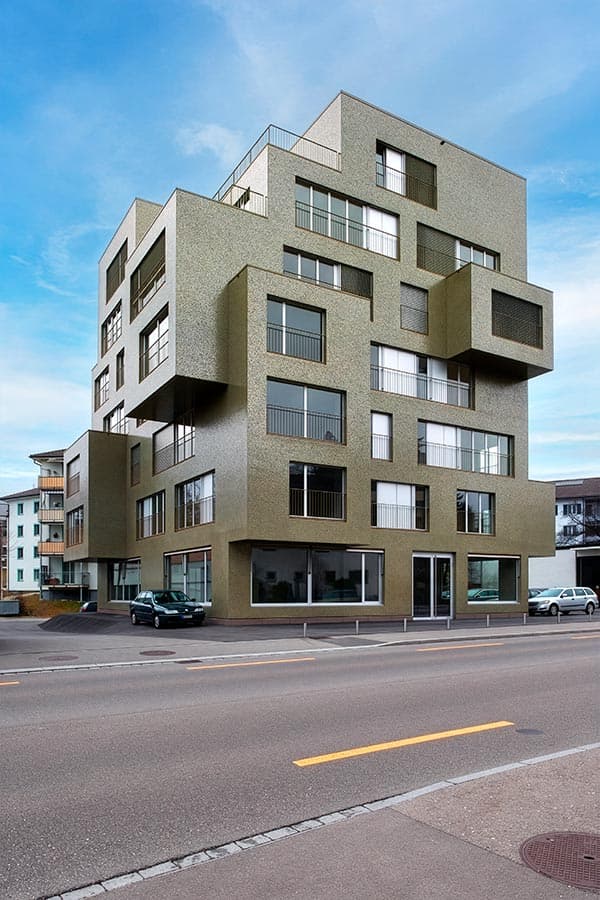
A facade defines how a building enters the landscape. It shapes identity, catches the light and establishes a relationship with everything around it. Cladding it in mosaic turns that surface into a living material, one that shifts through the day and accompanies the architecture for a very long time.
Thanks to the scale of its tesserae and its compositional versatility, SICIS glass mosaic can clad exterior facades, curved volumes, roofing and complex geometries with continuity and precision. A solution suited to residential buildings, commercial spaces, hotels, public venues and landmark architecture, developed through a process that combines creative freedom, technical expertise and installation support.
A mosaic facade can be essential, vibrant, luminous, iridescent. It can blend into its context or take center stage entirely. Modesty, in this case, is optional.
Solid-color fields build compact, deep surfaces, where the smallest variations between tesserae create a visual movement no uniform cladding could achieve. Degradé, instead, accompanies the architecture through calibrated color transitions: the tone intensifies, dissolves or follows the development of the volume, turning even the largest surfaces into dynamic compositions.
When the project calls for it, Pixel Decor introduces custom designs and patterns, legible from different distances and developed in relation to the building's proportions. Color palette, format, finish and tessera distribution are all studied to dialogue with the architectural concept, with natural light and with the surrounding environment.

A mosaic facade can be essential, vibrant, luminous, iridescent. It can blend into its context or take center stage entirely. Modesty, in this case, is optional.
Solid-color fields build compact, deep surfaces, where the smallest variations between tesserae create a visual movement no uniform cladding could achieve. Degradé, instead, accompanies the architecture through calibrated color transitions: the tone intensifies, dissolves or follows the development of the volume, turning even the largest surfaces into dynamic compositions.
When the project calls for it, Pixel Decor introduces custom designs and patterns, legible from different distances and developed in relation to the building's proportions. Color palette, format, finish and tessera distribution are all studied to dialogue with the architectural concept, with natural light and with the surrounding environment.
Mirrored surfaces, iridescence and reflections add a further dimension. The Mirror collection heightens this interplay with light through mirrored tesserae that reflect the surrounding landscape, turning the façade into an ever-changing architectural presence. The sky, the movement of clouds and shifting weather enter the surface and change it continuously. The building stays the same. Its facade, fortunately, keeps changing.
The modularity of mosaic also allows it to follow curved surfaces, organic volumes, transitions and changes in geometry, maintaining a visual continuity that's difficult to achieve with large, rigid elements. The material adheres to the form and brings out its character.
A facade faces sun, rain, frost, temperature swings, humidity and weathering. Glass mosaic offers properties that make it particularly well suited to outdoor use: low water absorption, color stability, UV resistance and a strong response to environmental and chemical stress.
Laboratory tests on specific SICIS collections document very low water absorption, resistance to chemical agents and staining, and a positive response to freeze-thaw cycles. Natural Collection samples subjected to 100 cycles between -5°C and +5°C, for example, kept the tesserae fully intact.
The vitrified surface also makes cleaning easier and limits the penetration of water and substances that could alter its appearance. Precise characteristics vary by collection and finish selected: SICIS therefore provides documentation and technical data to help identify the product best suited to the project's conditions.

A facade faces sun, rain, frost, temperature swings, humidity and weathering. Glass mosaic offers properties that make it particularly well suited to outdoor use: low water absorption, color stability, UV resistance and a strong response to environmental and chemical stress.
Laboratory tests on specific SICIS collections document very low water absorption, resistance to chemical agents and staining, and a positive response to freeze-thaw cycles. Natural Collection samples subjected to 100 cycles between -5°C and +5°C, for example, kept the tesserae fully intact.
The vitrified surface also makes cleaning easier and limits the penetration of water and substances that could alter its appearance. Precise characteristics vary by collection and finish selected: SICIS therefore provides documentation and technical data to help identify the product best suited to the project's conditions.
A facade's performance depends naturally on the entire system, the substrate and the cladding equally. Support structure, surface preparation, waterproofing, adhesive, grouting and joints should all be evaluated as parts of the same solution. Pull-off tests on complete SICIS configurations, carried out according to the EN 1348 §6.3 method, verified the hold of mosaic installed on multilayer panels, even after extended periods in contact with controlled water.
The result comes from the meeting of a resistant material and a correctly engineered installation. Even the brightest tessera prefers solid foundations.


Every facade presents its own conditions: dimensions, geometries, substrates, exposure, climate, site constraints and desired aesthetic outcome. SICIS works alongside architects, designers and contractors in defining the solution, bringing material expertise and process knowledge to the table.
Support can begin in the earliest design phases, evaluating colors, finishes, formats and compositions. Samples and mock-ups make it possible to verify the surface's effect in natural light and alongside the building's other materials. For Degradé and Pixel Decor, the design is developed at the facade's actual dimensions, to control rhythm, color transitions and overall legibility.
The creative phase is followed by technical development. The SICIS team collaborates on evaluating substrates and installation systems, prepares the drawings needed for production and organizes the mosaic to streamline work on site. In-house production in Ravenna allows direct oversight of quality, color composition and module preparation.
SICIS can also provide certified installation teams, able to carry out the work in line with the project specifications and the surface's characteristics. A single continuous process accompanies the project from the first selection of tesserae through to the installation of the last module.


SICIS has brought mosaic to the facades of residential, commercial, cultural, hospitality and public buildings across different countries and climate conditions.
In Napa Valley, the organic facade of Flora Springs Winery is clad in 630 m² of Degradé mosaic, developed through six shades of green. In Madrid, the 3,700 m² of Circo Price draw on the luminosity of Iridium mosaic to accompany the building's large cylindrical volume. In Wetzikon, Switzerland, Glimmer mosaic covers 1,250 m² of a residential complex exposed to a particularly harsh climate.
Mosaic has also shaped the mirrored surface of the SICIS Headquarters in Ravenna, the decoration of the Katara Mosque in Doha, and the large roof of the InterContinental resort on Shura Island, in the Red Sea.
Different scales, destinations and landscapes, with one element in common: using the facade to build an architectural identity that's immediately recognizable.
Designing a mosaic facade? Talk to the SICIS team to explore materials, color possibilities, technical performance and installation systems.